-1.png?width=5230&height=1198&name=unnamed%20(4)-1.png "Wayne Stiles")

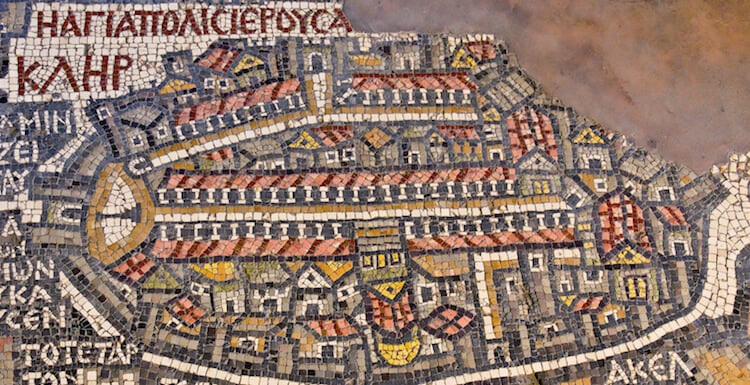
Whenever I visit the ancient Cardo street in Jerusalem, I like to look at the replica of the Medeba Map mosaic. It depicts the Holy Land as it looked in AD 580 and shows Jerusalem sectioned by crossroads. The divisions paved the way for the 4 quarters of Jerusalem.
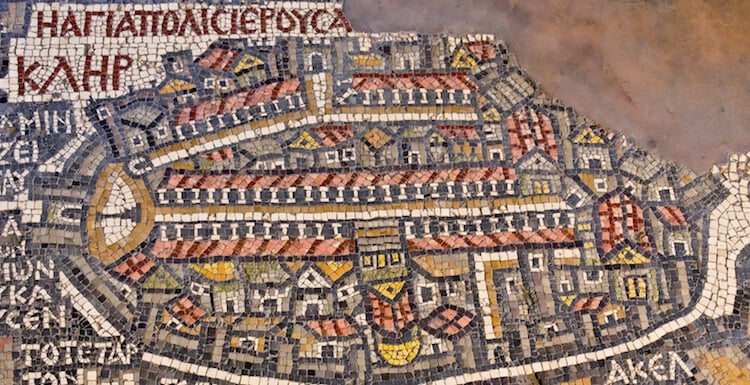
(Photo: The Medeba Map mosaic, showing the Cardo street at center. The Greek letters at top left read: “Holy City of Jerusalem.” Courtesy of the Pictorial Library of Bible Lands)
The annual celebration of Jerusalem Day, or Yom Yerushalayim, celebrates the reunification of Jerusalem. But can we really call the city unified? Although the capital of Israel enjoys a unification of Jewish control, there remains a wildly disjointed set of worldviews.
The 4 quarters of Jerusalem represent, in small manner, the ongoing contentions that have existed for centuries. But one day the 4 quarters of Jerusalem will be unified.
Here’s how.
A Crossroads that Quarters Jerusalem
In the second century, the Roman Emperor Hadrian determined to make Jerusalem a Roman city (actually, a non-Jewish city).
- He renamed the city “Aelia Capitolina” and changed the name of the country from “Israel” to “Palestine”—a designation it retained until 1947.
- He constructed a north-south road through the heart of the city, a street called the Cardo (related to the Latin term for “heart”). The southern end of this road wasn’t constructed until the time of Justinian in the Byzantine period.
- The east-west crossroad was called the Decumanus, a thoroughfare that stretched from the area of today’s Jaffa Gate to the city’s center.
Archaeologists discovered the Cardo in the 1970s and the Decumanus in 2010 during the Jaffa Gate renovation. The location of these ancient crossroads still section off the four quarters of Jerusalem.
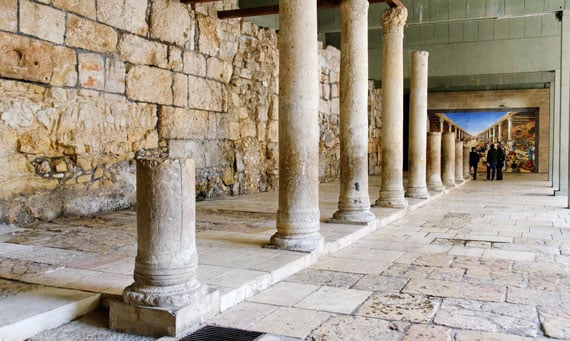
(Photo: The excavated Cardo street in Jerusalem with reconstructed columns. Courtesy of the Pictorial Library of Bible Lands)
The 4 Quarters of Jerusalem
- The Jewish Quarter contains, among many other significant sites, the excavated Cardo, the Western Wall plaza, and the priciest residential real estate in Jerusalem. To me, there is no more beautiful part of the Old City.
- The Armenian Quarter exists, largely because country of Armenia holds the distinction of being the first nation to officially adopt Christianity. Since the Edict of Milan in AD 313, Armenians have lived in Jerusalem. The Armenian Quarter is the smallest of the four, with the Monastery of St. James occupying most of the space.
- The Muslim Quarter takes the lion’s share of the Old City, as well as more than three-quarters of its population. It also includes the Temple Mount and the beautiful Church of St. Anne.
- The Christian Quarter features, most importantly, the Church of the Holy Sepulcher, the traditional location of the crucifixion, burial, and resurrection of Jesus. The Christian Quarter also houses many shops, most of which, ironically, are owned by Muslims.
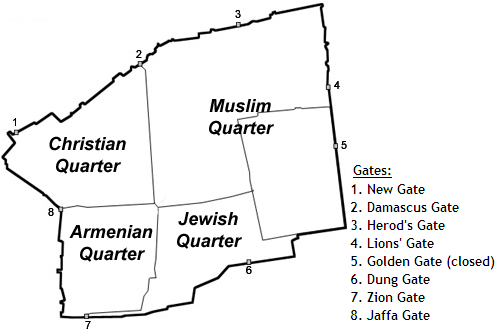
(Quarters and gates of the Old City, from Wikipedia Commons)
In spite of these clear divisions, the 4 quarters of Jerusalem have ironic overlaps:
- On the line between the Jewish and the Muslim Quarters, Jews bow in prayer at the Western Wall with Hebrew Scriptures in hand.
- And yet—on the Temple Mount, no Bibles are allowed.
- The Muslim call to prayer blares over the whole city multiple times a day, even across those quarters that ignore the call.
- And yet—inside St. Anne’s Church in the Muslim Quarter, Christians from around the world sing praises to Jesus many times a day.
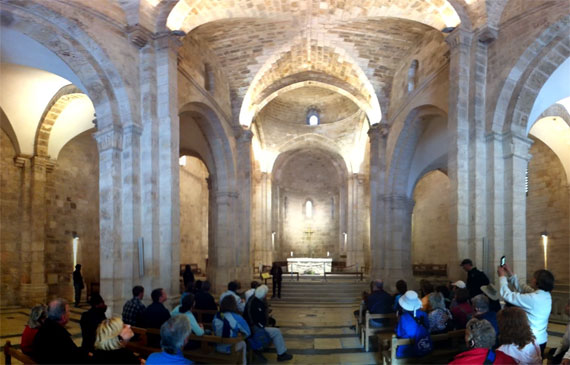
(Photo: A group singing in St. Anne’s Church in Jerusalem)
Only One Solution to the Division
With all this diversity in the 4 quarters of Jerusalem, it becomes clear that there is a difference between the “reunification” of Jerusalem and the “restoration” the Bible predicts.
The Prophet Zechariah promises that even though “the nations” will attack the city, the Messiah will come and bring a restoration that includes complete reunification:
The LORD will be king over all the earth; in that day the LORD will be the only one, and His name the only one . . . and there will no longer be a curse, for Jerusalem will dwell in security. —Zechariah 14:1–11 (see also Luke 21:20-27)
Scattered across the skyline of the Old City protrude all manner of crosses, crescent moons, and Stars of David—like a tangle of wheat and tares.
No doubt, as Zechariah wrote, it will take a Messiah to sort it out.
Journey Through The Bible Lands Without Leaving Home
Enjoy a more vibrant relationship with God and deepen your understanding of God's Word by experiencing the Holy Land from wherever you are.

Tell me what you think: What do you think peace in the Middle East will look like after the Messiah comes again? To leave a comment, just click here.
Click here to leave a comment.
.jpg?width=350&name=Wayne-books-350wide%20(1).jpg)