What’s new always looks like the answer. I’ve believed that more times than I care to count.
When the Apostle Paul came to Athens on his second missionary journey, he found a city with that same hunger. God has set eternity in the human heart (Ecclesiastes 3:11), and they tried to fill it with idols—many idols, because you can’t fill an eternal space with that which amounts to nothing.
Video courtesy of walkingthebiblelands.com.

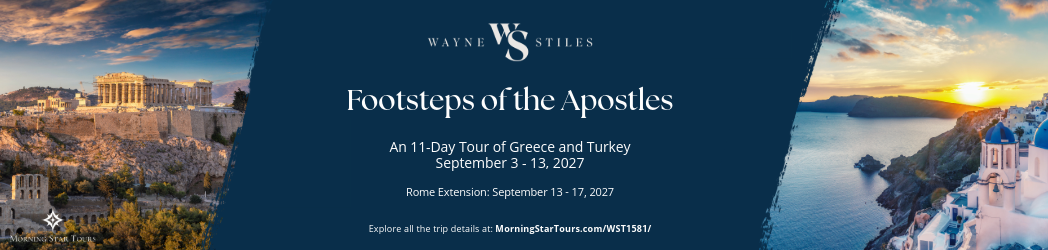
Paul reasoned in the synagogue, and he also reasoned every day in the marketplace with whoever happened to be present (Acts 17:16–17). That marketplace was the Agora, the large open area just below the Acropolis, and it housed temples as well as stalls. The temple of Hephaestus, built around 450 BC, was already standing when Paul walked through. It remains the best-preserved of the Greek temples in Athens.

Some of the Epicurean and Stoic philosophers took an interest. They called him an “idle babbler”—a seed-picker, a scavenger who collected other people’s ideas and passed them off as his own. The charge almost makes you smile, because the Athenians were doing the same thing.
Now all the Athenians and the strangers visiting there used to spend their time in nothing other than telling or hearing something new. —Acts 17:21
They even took Paul up to the Areopagus, or Mars Hill, and asked if they could know what this new teaching was (Acts 17:19). The name Areopagus means Hill of Ares—Mars, in Latin. In Paul’s day, the council often met down in the Agora, so it isn’t certain whether “the Areopagus” in Acts points only to the people or also to the place. Tradition puts his words on that rock. Today Mars Hill is a barren rock, worn smooth by the millions of feet that have shuffled over it. At the base of the hill, Paul’s sermon is written in its original Greek.

Paul wasn’t introducing a new deity, as they claimed. He pointed to an altar they had already built, inscribed “To an Unknown God,” and he named the God of creation they had experienced but didn’t know. Standing in the shadow of the Parthenon, above a city of temples made with hands, he told them the true God doesn’t dwell in those temples. He gives life and breath to all. He isn’t one more idea to add to the pile.
That’s why, to Paul, the new word was the old Word.
Paul later warned the Colossians not to be taken captive through philosophy and empty deception, rather than according to Christ (Colossians 2:8). The Scriptures are “living and active” (Hebrews 4:12). They stay fresh in every age because they speak of truths that are timeless.
Even as Christians, we can fall for our own version of this. In truth, it all boils down to one thing. We have to personally spend time in the Bible in order to personally benefit from it. There’s no shortcut to true growth. But the path is clear.
Tell me what you think: What new thing have you been hoping would do the work that only time in God’s Word can do? To leave a comment, just click here.